






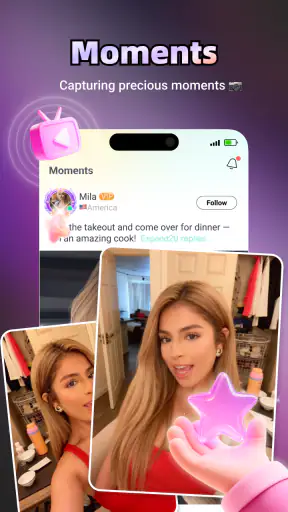


I approached LiveUp- Video Chat as a lifestyle app for people who want to meet and talk with interesting people through live video rather than relying only on text profiles. That distinction matters: the appeal is not simply browsing a social feed, but moving toward a more immediate conversation where voice, expression, and timing all influence the experience. In my view, it is best understood as a casual discovery tool for social interaction, not as a replacement for a private messenger, a dating service with guaranteed outcomes, or a carefully moderated community built around one hobby.
The app is made by Insight-Innov and is available free of charge, which makes trying it relatively straightforward. It carries a Mature 17+ age rating, so I would not recommend treating it as a general family-friendly chat app. Its store summary focuses on finding more interesting people, while the short description identifies it as video chat. Those two details set the right expectation: the central value is meeting unfamiliar people in a visual, live format, and the quality of that experience depends heavily on how comfortable you are with spontaneous conversations.
How the free starting point affects its value
The most important cost detail is that the app can be downloaded and used without an upfront purchase. That gives LiveUp- Video Chat a low-risk entry point for someone who is curious about live social discovery but does not want to commit to a subscription before seeing whether the format suits them. At the same time, the app includes in-app purchases ranging from $0.20 to $249.99 per item. That is a very wide purchase range, so I would approach optional spending carefully rather than assuming every useful interaction is included in the free experience.
For me, the sensible way to evaluate the app is to separate free access from paid value. Free access answers the question, “Can I try the basic idea?” It does not automatically answer whether paid items are worthwhile. Since the available purchase amounts vary substantially, I would first use the app long enough to understand what the free experience offers, then decide whether any optional purchase solves a problem I actually have. Buying simply because a conversation feels exciting is an easy way to spend without knowing what additional value you are receiving.
The app has a 4.2 average from around 7.9 thousand ratings, and it has passed 5 million installs. Those figures suggest that the concept has reached a substantial audience and that many people have found enough value to engage with it. They do not guarantee that every new conversation will be enjoyable, though. Live social apps are unusually dependent on timing, personal preferences, availability, and the behavior of other users. I would read the popularity as a reason to test the app, not as proof that it will match my personality or communication style.
Its current version is 4.3.6, and it supports devices running Android 7.0 or later. That makes it accessible to people using older Android hardware, although a smooth video-chat experience still depends on the phone, camera, microphone, connection, and surrounding conditions. I would check those basics before judging the app too harshly. A weak connection or a noisy room can make a promising conversation feel awkward even when the app itself is working normally.
What the app delivers beyond ordinary messaging
The strongest reason to choose this kind of app over conventional messaging is immediacy. Text lets people edit themselves heavily, delay replies, and leave much of their personality hidden. Video chat creates a faster sense of whether a conversation feels natural. I like that possibility because it can reduce the endless back-and-forth that often happens when two people are technically interested but never move beyond short written messages.
That immediacy also makes the app useful in a very specific everyday situation. Imagine finishing work with no plans for the evening and wanting a brief social exchange rather than another passive scroll through a feed. LiveUp- Video Chat can fit that moment better than a standard social network because the activity is centered on meeting and talking. I would open it with a modest goal—perhaps a few relaxed conversations—not with the expectation that every session will produce a close friendship or a memorable connection.
A practical tip is to use the first part of a conversation as a quick compatibility check instead of trying to force it into something meaningful. Notice whether the other person listens, respects the pace, and responds to what you actually say. If the interaction feels one-sided or uncomfortable, ending it early is more useful than staying out of politeness. This is one of the less obvious skills required by live video platforms: the app may make introductions easy, but the user still has to manage boundaries and time.
Another useful approach is to treat video as a filter for communication style, not as a guarantee of trust. Seeing someone live can make an exchange feel more personal, but visual presence should not be confused with knowing the person well. I would avoid sharing sensitive information, financial details, private contact information, or anything that could create pressure later. The Mature 17+ rating is an important reminder that this is not a space I would hand to a younger user without careful supervision and a clear understanding of the risks.
Where the experience can become frustrating
The same live format that makes the app engaging can also make it tiring. If I am in the mood for quiet browsing, thoughtful reading, or conversations around a clearly defined interest, a video-first environment may feel too immediate. A regular messaging app is better when I want to answer on my own schedule. A community platform is usually better when I want to find people through shared topics, projects, or long-form discussion. LiveUp- Video Chat is more suitable when the act of meeting and speaking is itself the main activity.
There is also a natural quality trade-off in open-ended social discovery. Not every person I encounter will be engaging, respectful, or available for the kind of conversation I want. That is not a flaw unique to this app, but it is central to deciding whether the format suits me. I would expect some introductions to end quickly and would not interpret that as failure. The app can create opportunities, but it cannot remove the unpredictability that comes with talking to strangers.
Video also raises practical friction that text does not. I need to think about lighting, background noise, privacy, and whether I am comfortable being seen at that moment. If I am commuting, sharing a room, or dealing with an unreliable connection, a live video session may be inconvenient. A useful workaround is to decide in advance when I am actually available for visual conversation instead of opening the app whenever I am bored. That small change makes the experience feel more intentional and reduces the chance of ending a session because the environment is unsuitable.
Paid items introduce another point of friction. The presence of purchases from a few cents to $249.99 means I would not tap through payment prompts casually, especially during an emotionally engaging conversation. I would review each purchase before confirming it and keep my use of optional spending separate from my judgment about whether someone is genuinely interesting. The free entry point is valuable because it allows testing; it is less valuable if I start paying before I understand the limits of the basic experience.
Who is most likely to get real value
I think LiveUp- Video Chat is a reasonable choice for adults who enjoy spontaneous conversation and prefer seeing and hearing people rather than exchanging messages for a long time. It may suit someone who has moved to a new place, works from home, or simply wants a more active alternative to scrolling through social content. It can also appeal to people who are comfortable deciding quickly whether a conversation deserves more time.
The app is less convincing for someone who wants a highly structured purpose. If I am searching for professional networking, language practice with defined learning tools, a local activity group, or a community organized around a particular subject, I would choose a service designed for that goal. Likewise, someone who strongly dislikes being on camera should not download it expecting the visual element to be incidental. The central format is the point, so discomfort with live video is a strong reason to skip it.
It is also not my first recommendation for a person who wants predictable, private communication with people they already know. A familiar messenger offers better control over contacts and timing. LiveUp- Video Chat makes more sense when discovery is part of the appeal. That difference is easy to miss if I focus only on the word “chat.” This is not simply another inbox; it is a more exposed and spontaneous way to start conversations.
For a cautious new user, I would begin with a short session and establish personal rules before using it regularly. I would keep conversations general at first, end interactions that cross my boundaries, and avoid treating a friendly exchange as evidence of a trustworthy relationship. I would also decide whether the free experience already meets my needs before considering any purchase. Those habits do more to improve the experience than spending more money or staying online longer.
How it compares with familiar alternatives
Compared with text-based social apps, LiveUp- Video Chat offers faster personality cues but less control over presentation. Text is easier to pause, edit, and revisit; live video is better at revealing conversational rhythm. Compared with traditional messaging, this app is aimed at meeting unfamiliar people rather than maintaining an existing circle. Compared with interest-based communities, it offers less obvious structure around a shared topic and puts more weight on the chemistry of the individual conversation.
That comparison helps clarify its value. I would choose it when I want the possibility of an immediate, human-feeling exchange and I am willing to accept uneven results. I would choose a different option when I need privacy, asynchronous replies, a focused subject, or a clear outcome. No purchase can remove those format-level trade-offs. The app’s free availability makes experimenting sensible, but the right alternative still depends on what I want from social interaction that day.
My verdict after weighing the trade-offs
My overall view is cautiously positive. LiveUp- Video Chat has a clear use case: it gives adults a way to look for new conversations through live video, and its free starting point makes that idea easy to test. The audience size and 4.2 average indicate that it has found meaningful interest, while the 17+ rating correctly signals that users should approach it with adult judgment and sensible boundaries.
I would recommend trying it if spontaneous video conversation sounds appealing and I am prepared for mixed results. I would not recommend paying immediately, assuming every interaction will be worthwhile, or using it as a substitute for a private messenger or a focused community. The best value comes from treating the app as an experiment in meeting people, using the free access to learn whether its style fits, and making optional purchases only when their purpose is clear.
In short, I would keep LiveUp- Video Chat installed for the right kind of social mood: curious, available, and comfortable with a little unpredictability. I would skip it if I wanted quiet browsing, tightly controlled contacts, or conversations organized around a specific goal. My buy-or-skip verdict is simple: try the free experience first, protect your privacy, and spend only when the added value is obvious to you.


